What drew you to the theme of sailing as a subject?
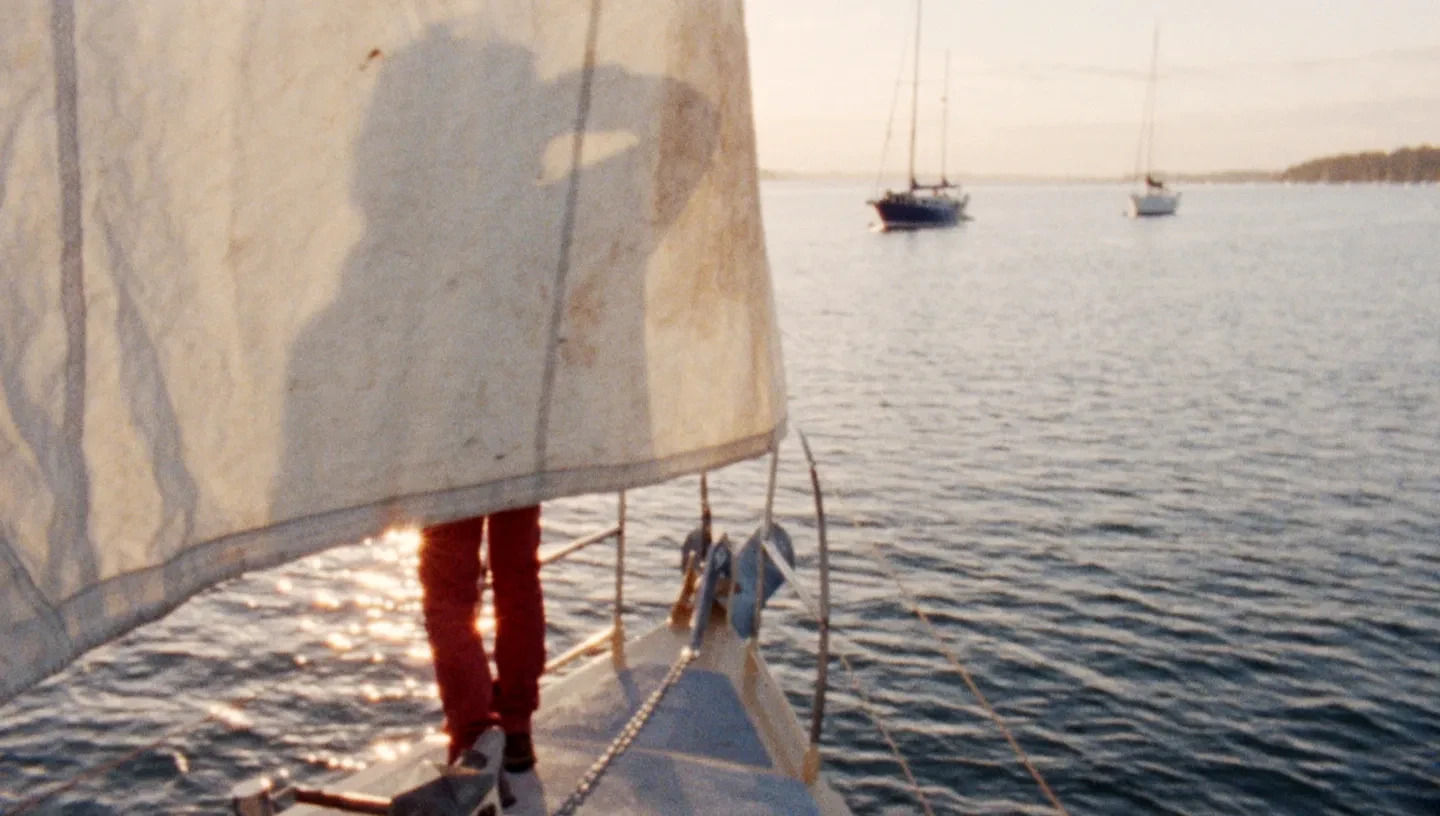
My sister, who’s in the film, had just come back from a long trip. She left the UK when she was 19 and essentially hitchhiked on boats. She came back four years later and bought a small boat which features in the film. And I went to visit her and sailed for the first time, and it was the first time sailing on her own too. I instantly had this sense… it’s not that you can describe it or it might be very cliché to describe. But a sense of freedom, being with the elements but utilising them in the same way.
We were really just messing around in the River Orwell. She was having to do a lot of stuff under sail and that was the initial inkling of maybe there’s something interesting, and a link between my filmmaking. Especially sailing without an engine, such as a guy called Stevie Hunt in the film that completely removed his engine and living in his car in the boatyard. Living on the water is sometimes called the last freedom we have in the UK, which is now being eroded in places like London with the canal boats. Senses of freedom with the sailing and the living, an element of autonomy that drew me to it.
And what about shooting on 16mm, did you know from the very start you wanted to use film?
Yeah, I’ve made two previous films on 16mm. The interesting thing about this film is the conversations between the process of shooting 16mm and being engineless, which I also wrote about in the book that accompanies the film.
It’s not an aesthetic decision, which I feel is why we’re drawn to 16mm – especially when it’s hand developed with colour film. But that’s difficult, this wasn’t hand developed. But because in a sense you’re restricted, both myself and the sailors felt less anxious in a way. The wind dies, and you just stop. If you don’t have an engine and the wind’s in the wrong direction, then there is nothing you can do about it. And I think that related to filmmaking as well.
I would try and work out how much film I could fit, afford. And when the film runs out, the film runs out. There’s still a tension of being really prepared, but when filming I feel more present.
But I’m not a purist. It gets digitalised, I edit digitally, I use digital sound – I record a lot of sound. If you clip a microphone onto someone and you’re filming for six hours, I get this weird thing where I end up with six minutes of film but six hours of audio.
It sounds really incredibly difficult both shooting on a boat and then also film. Were there any points that you may have questioned shooting on film?
I don’t think I questioned shooting on film, but I did question why I was making this film… that seems like a pretty common process for me.
There were moments when the cameras got jammed. The first scene flips to Super 8 because the camera got jammed. It was a relatively short trip, out in a river in Cornwall. You can change 16mm film in the light and you lose a bit of the beginning, but I was really trying to conserve film by doing it in the dark bag. But the only place was down below in a small boat, and every time I went down below I would build up a desire to be sick. I’d come up from below, be sick, and carry on filming.
And filming on my sister’s boat. Weirdly, in a calm situation where we were just pulling anchor up, the classic thing happened where the boom swung and hit me. Suddenly I was just knocked by this massive force. Somehow I managed to grab the metal wires that hold the mast up, swing off the boat, then on the boat, then tumble over. The funny thing was I had my camera really tight, above my head protecting it. If I had fallen overboard, the camera would have been held above my head basically as an instinct.
What was the editing process like?
Honest answer is that it was very difficult. I didn’t have tonnes and tonnes of footage, maybe six hours. At first I thought it wouldn’t be too difficult.
But because the film goes between a few boats and characters, and because there wasn’t a narrative and I try to resist the obvious narratives, it took quite a bit of time to find the film in the edit. It was about four months of editing, not constantly but it took a couple of months to take shape. Some things were obvious and some scenes were obvious. There’s a sense of flow of what’s happening so in the best case you don’t need to do too much editing. Then what scenes go where and why was tricky. It ended up being centred around getting my sister’s boat ready and relaunching it.
I’ve had some, I suppose, quite good feedback on the film where it’s kind of an artist’s film. On the boat tour someone said, “After about ten minutes, after I realised nothing was going to happen, I got into it.”
And 16mm, maybe more 8mm, is often associated with holiday footage or travelling. Did that affect the final product?
At the beginning I thought there might be a sense of using that 8mm camera in a more informal way. As I had an underwater camera, maybe jumping off the boat and things like that. But it didn’t work out. I tried to avoid the aesthetic or connotations to try and focus on the technical aspects.
But it certainly does add to the sense of the “outside of time” effect, where the digital HD effect is maybe quite harsh.
There is a romanticism to sailing, but I tried to not make a romantic film about sailing. And those things like “there has to be a big storm” and this overcoming of something, overcoming the natural world as dangerous. This was more about how do people connect with the natural world, and these distinctions are kind of blurred for sailors maybe more than on land.
Do you have any tips or advice for people that might want to shoot analogue?
When I started, I did a really personal project. A film about my dad. I borrowed a camera and I didn’t shoot very much film, but made a short film.
My advice would be to borrow a camera and make something really simple. You can buy a camera for cheap and get the film and send it to Kodak, and get it back in two days. Just shoot one roll, doesn’t matter what it is. It’s just the joy of getting it back and going, “So that’s what it looks like”.
And record some audio, even if it’s on your phone. It’s really nice to get the film back and put on some ambient sounds, and suddenly it changes the sense of the image. And that’s a really interesting thing to experience as it makes you think about what’s happening between the sound and the image.