Courtesy of Organic Publicity
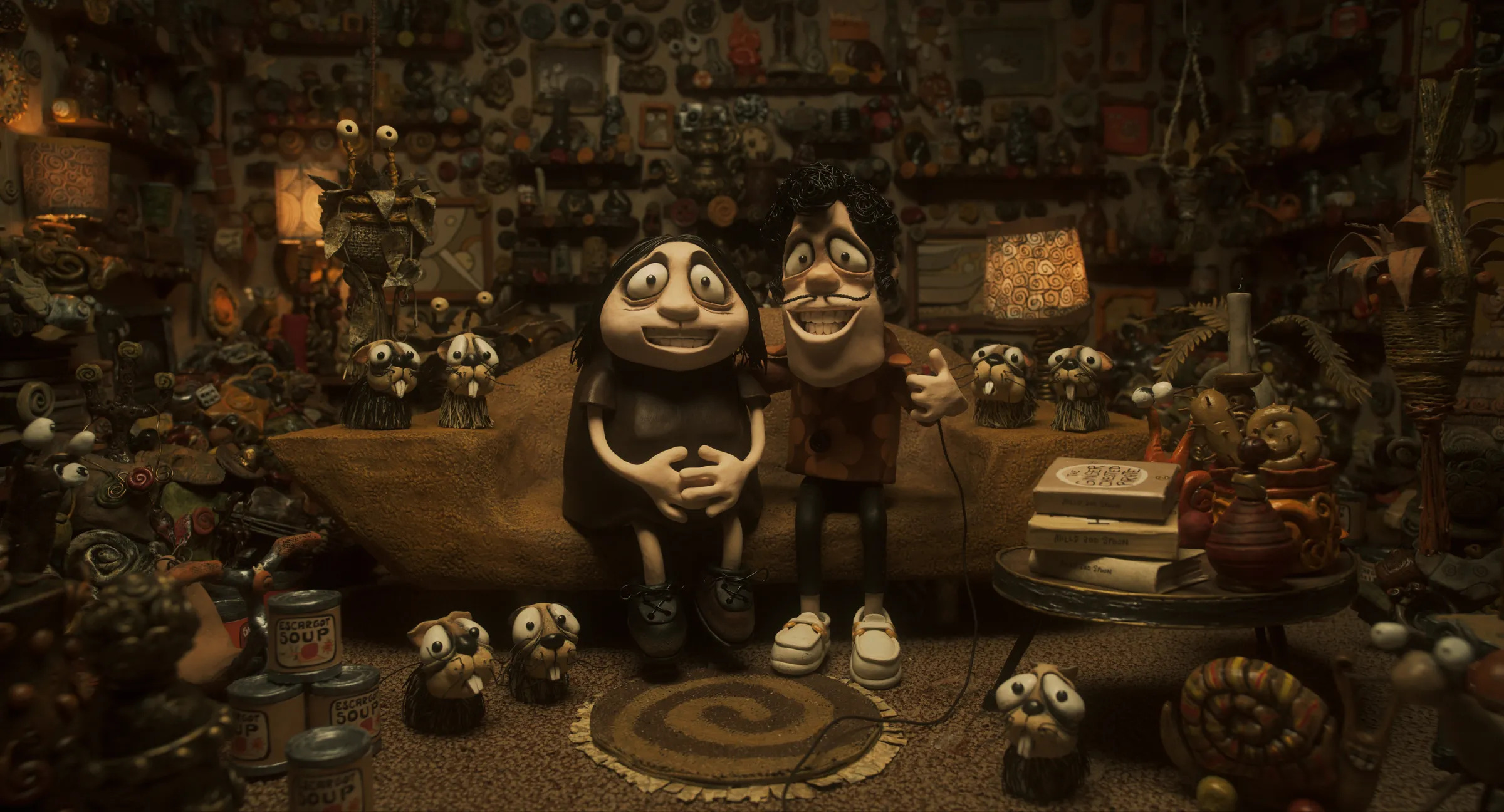
Memoir of a Snail is a stop motion feature from Academy Award winner Adam Elliot. Like many of Elliot’s animations, it features a rich visual style that is given a weighty emotional value through its melancholic narrative based on personal experiences.
First I first wanted to ask about the time scale of the film.
Well, you know, it was never meant to take eight years and wasn’t meant to be 15 years between this feature and my last feature, “Mary and Max”. There’s so many things that slowed us down. And of course, COVID was the big one. But financing was really tricky because things have changed a lot in Australia. The government used to just give you a big check. And now it’s much tougher. But I’m one of the lucky ones where each film has been fully financed. But also life got in the way. My father dropped dead and I had to start caring for my mother. My former producer and I went our separate ways. Of course stop motion’s incredibly slow to make. So there’s that as well.
I was giving a talk to some little kids a few years ago, even though my films are not for kids. And this little girl said “how long does it take to make a film?”. And I said “about five, 10 years”. And then “how old are you?” And I said, “I’m 52”. I said, “Any more questions?” And this little boy put up his hand: “Well, I’ve worked out you’ve only got two left”.
I’m a big fan of almost, small genres or quite descriptive genres. And I saw that you kind of coined your own genre, which is a “clayography”. Can you talk me through what that is?
Yeah, it’s a pretentious word I invented because I couldn’t find a word that described what I do. There’s of course “claymation”, but that’s a trademark. “Stop motion” is very general too. And I knew that I always wanted to make films about my family and friends and myself. But I really wanted to celebrate the clay as well. A lot of stop motion isn’t clay, it’s other materials. And I just love clay because it’s very primeval. It’s a very tactile medium. So yeah, I came up with “clayography”: clay-biography. And now it’s on Wikipedia. I’m probably more proud of that than anything else.
And with that kind of personal touch, how do you ensure you keep that when working with a larger team?
Yeah once the script is locked off, we really do adhere to it and we don’t deviate. So that really helps us not move into dangerous territory where you can become a bit too cartoonish, where we’re constantly striving for these little blobs of clay to be believable and authentic.
I’ve always said “if you’re not an emotional wreck by the end of one of my films, then I failed”. So even though it’s animation, we are striving for authenticity and that’s tough. It’s really hard to get the audience to give over. So we use all sorts of devices like, you know, we use very emotional music and of course trying to get an actor to give a voiceover that’s very intimate. Like Sarah Snook (who voices Grace Pudel) gave a very intimate performance. All these little tricks helped to give it that personal touch.
And the themes of the film, are kind of themes of collections and also family. What drew you to those aspects?
Yeah, well, my father, you know, he died about eight years ago - and he left behind a big pile of stuff. I wouldn’t say he was a hoarder, but he certainly collected a lot of stuff. And so I became fascinated with why as human beings do we fill our homes full of things? Why do we collect? why is that? So I went into the psychology of all that, read a lot of books, did a lot of research.
I mean, I hoard, I have very detailed notebooks and I collect sounds and smells and interesting words. and that’s what I use as my recipe books for all the ingredients for my films. But yeah, I think humans are one of the few species that do collect things that are unnecessary. I think magpies and bowerbirds are the other creatures that do that. But most other animals that collect things do it out of necessity, whereas we collect things for sentimental reasons.
And how would you think your style has developed from your early films to now?
I think it’s evolved a little bit and I’ve always wanted it to not evolve too much and this film I’ve actually tried to go back to the aesthetic of my early shorts. I found “Mary and Max” was getting a bit too refined and slick. And I don’t like slick - I like lumpy, bumpy, chunky, wonky. And, you know, it’s because we really want to make it clear to the audience that this film is handmade and things that are handmade are generally imperfect. And I love striving for imperfection, which is why I put the Kintsugi bowl sequence in the film, because my characters are imperfect to look at, but also their psyches are imperfect. A lot of them are broken, damaged people, particularly people like Ken, know, Ken’s damaged goods.
But I try, you know, I try not to demonize any of my characters. I respect them. They might be broken or do things that are improper, but you know, I think we all make mistakes. And what links all my films together is that I’m just really trying to say to people: “Look, We’re all flawed. We all have something about ourselves we don’t like. Let’s stop trying to fix each other. Let’s just embrace our lumps and bumps and get on with life.”
Animation has always had an association with children. Do you think that association is still strong or do you think the kind of films that are coming out, including this one, deviate from that.
Oh, look, I think it’s still there for sure. But it is changing and getting better. And I get emails all the time from parents who say “your films are not for children.” And I say, “No, why are you taking your children to my films? They’re rated R, you shouldn’t be taking your children to my films”.
And look, I blame Disney. Because we’re all brought up on Disney and Warner Brothers and we’re all brainwashed into thinking it’s a genre and it’s not a genre. Guillermo del Toro said it beautifully in his speech a few years ago with Pinocchio at the Oscars. He reminded us “it’s not a genre, it’s a medium” and it always has been. And there’s a wonderful history of adult animation out of countries like the Czech Republic, and Estonia, and France. I think it’s really America’s fault. Also if you go look at Disney films and shorts from the 50s or 60s. They’re so racist, homophobic. So I would argue those films are not for children.
And I was wondering about the difference between maybe mainstream films that release globally all at once, how it’s different from a director’s perspective to slowly go country by country.
It premiered in France at the Annecy Animation Festival and we won the big crystal grand prize there. And then London Film Festival, yeah, we won the whole thing, which was a big shock.
Well, from a selfish point of view, I’d love my films to release all at once, because I’ve been on I’ve been doing a year of publicity, which is almost over now. And of course, as an auteur, that’s really problematic, because it means I’m not writing, I’m not getting the next film up and running. But that’s just the reality. And look, it’s wonderful too that the films like mine are getting theatrical releases and aren’t going straight to streaming. And if you want to have a theatrical, then you’ve also got to put in a lot of hard work, do a lot of media, travel to each country. And also remind yourself that we’re so lucky that people still go to the cinema and that the communal experience is still desirable.
I think comedy is always worth better when you’re sitting in a room with 300 other people. And what’s been great is going to all these different countries and talking to cinema operators. And they’re all telling me that the people who are coming back to the cinema now, especially after COVID, are young people. So that’s fantastic. It’s not the baby boomers who’ve got lots of money. It’s young people who’ve got no money, who are spending and they’re a lot more selective. And I know when the lights go on in the cinemas, I look up and it’s all young people, which is great. So as I’m getting older, my audience is getting younger.