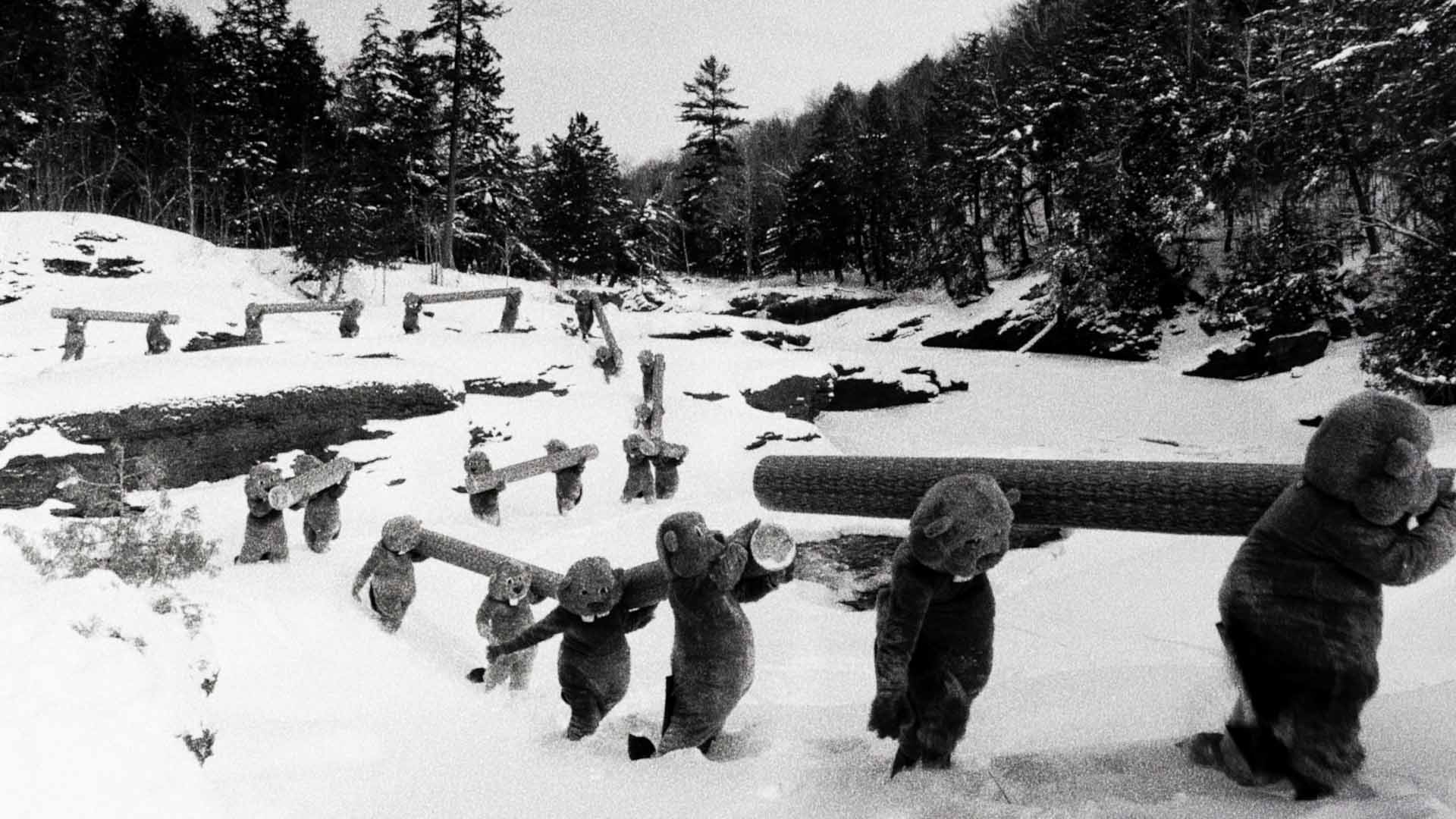
Have you ever had to fight against hundreds of beavers for the approval of your soon to be father in law? This is the premise of director Mike Cheslik’s inventive silent slapstick film that has been touring film festivals and cinemas alike. I had the opportunity to talk to DOP Quinn Hester, where we covered the artistic vision and harsh filming conditions behind the scenes.
For the cinematography, it’s all black and white, and a lot of it is very white because of the snow. Was that a kind of challenging aspect?
You know, it’s interesting. It wasn’t challenging per se. It’s a testament to Mike and his ability to just plan every single shot. I think he spent two years storyboarding every single frame. We had a binder full of storyboards, which is really our shooting script.
So we knew exactly what we needed, what negative space had to be at what part of the frame. So working with the white snow, a lot of the time we actually wanted to lose detail in it because we wanted it to feel more like a cartoon. To simplify the image in a way and just make it very clear.
Working with the white snow wasn’t a huge challenge. You’re used to working with maybe more lighting and you are really meticulously plotting out lighting cues. But this was a very different approach, but in a way that was extremely, extremely fun.
With the silent film aspect. It’s both silent in its homages to slapsticks like Buster Keaton, and the fact there’s no dialogue. How do you navigate something where you can only tell it through visuals?
Right. Again it’s the planning and process. Mike knew exactly what he wanted and executed his vision. He knew exactly every day what we had to do. Sometimes we would scout on the day and say: we have this location at our disposal, let’s find these shots at this location. Other times we scout ahead of time.
But as a DP working visually, it’s amazing because you don’t have to worry about dialogue in one sense. It frees you up because you are just collaborating very closely with the director on the visual language of the movie.
So with the influences, we would bring Buster Keaton up a lot and Guy Madden. Werner Herzog because of being in those extreme conditions. It made my job very easy to be hon est. It’s really just executing, executing, executing every day. How do we make these frames work? How do we make this visual gag work through editing? Mike’s such an incredible editor on top of it, so he knows what he wants visually but also how it’s gonna cut together.
We would shoot and there’d be moments when even I’m like: man, I know it’s in Mike’s brain. I know we’re doing all these fragmented shots, like these little moments. But I can’t person ally see it yet, even though it’s there. Mike would do cuts at the end of every day. He’d do like rough VFX and it would always work, always make sense. So great for the crew to see and great for morale.
What kind of equipment were you using?
Very minimal on the camera side. We had a Panasonic GH5 DSLR and two lenses. A zoom lens and very wide, 14mm or something. But, it worked so well in the conditions. Previously I kind of looked down upon DSLRs but when I became involved with the project, they had actually shot the entire first act of the movie. And they said this camera worked great in zero degrees (-17 C). You don’t need extra batteries. The small little stock batteries worked out, we had about six of them. I’m like: really? That’s it? You don’t need any brick batteries? Noth ing else? In the snow, in the cold, it always worked. We never had any technical problems with it. I was extremely impressed. And the quality of that, the colour science is extremely dialed in now with those DSLR even.
And when you’re in those circumstances where you’re working very remotely with limited crew and resources. You don’t have a trailer, you don’t have power. You had to just keep things very small.
Everything fit into a little backpack and we would take that on ahike in the woods. A mile or two and set it up and then we’re good to go for the whole day, daylight hours. So very min imal equipment. We had a truck full of props and costumes. Minimal lighting, had a couple 60Cs and then some grip equipment. But that’s really it. The main tool we used aside from the camera was this giant, 20 by 20 green tarp that we’d set up on locations to get knockouts for the characters so the lighting would be consistent.
You mentioned hiking and cold weather, what was the hardest part of physically shooting this film?
It was difficult in that we were put through the wringer: getting up at four or five in the morning every morning, then sometimes you have to drive two hours, it’s still dark, it’s 14 below. Arrived at the location at like 7, barely light. Then unloading the car or truck and hiking gear for a quarter mile, mile, two miles. Sometimes down a ravine, you’re sweating and you’re freezing. Then you start shooting and there’s a lot of times you’re not moving. So I was always trying to stomp my feet behind the camera, trying to keep my feet from freezing off.
And Ryland is just incredible, he’s the toughest guy I’ve seen in my life. He’s out there, prac tically naked in the snow crawling around. Then swinging from trees. It’s just incredible and the guy never complained: “What’s the next shot? Let’s go. Let’s do it. ”
The conditions are much more difficult if you don’t have a good team. As harsh as it was physically, it was so fulfilling and there were never any moments on set when I was upset. Or anyone else just because we knew we were putting our efforts towards something that was going to be great, that people would love and enjoy. And that I really cherish that honestly.
I remember one day in the middle of shooting where several times we had to hike gear a mile down this ravine. We had these sleds and put all the C stands and equipment and props on it. We’d hike it down and back up. You know, I don’t want to think about it again. I think we went through more than I think we can even process at this point. I mean that in the best way possible.
It sounds like quite communal filmmaking, how big was your crew?
It would depend on the day but our core team is me, Mike, Rylan, our PA Max, Eric West. And then a couple of additional folks we’d have come in. Sometimes we’d have like 12 like the big fight sequence in the barn. But in those winter months, like in the second and third act, that was a very small core group. Six for the most part and I remember a lot of the times it was just me, Mike, and Rylan out.
And what was the shooting schedule?
Once we got to the outdoors, it was fortunately limited to daylight hours. I think like five in the morning until four or five in the afternoon. Sometimes eating lunch, sometimes working through it.
It’s very unique in that there aren’t many film projects where not only are you having to 23 shoot a movie, navigate all the nuances and the creativity and the egos that come with that. But you’re also doing it in an environment where you’re kind of surviving. Your brain is in survival mode. You’re very focused on filming but at the same time, you’re like: if we stand still long enough, we’re all going to just die out here. Which makes you more focused, which is crazy.
You talked about focus and that’s interesting because the protagonist is very focused on specific beats.
First and foremost we didn’t want to confuse the audience. We wanted them to know ex actly what we wanted their attention focused on and whatnot. And the same thing with the character as well, very focused motive right? He’s got to get these beavers to win the girl. Rylan is a hero to me, at least in real life. But we all went through our own hero’s journey in a way.
Did you manage to catch the film at any festivals or screenings and what was your reaction to it cut together?
It’s an incredible movie to watch with an audience and so satisfying to hear people enjoy it and for different countries to respond differently. I’ve watched it in Brazil, Switzerland, and the States. Obviously every country has its own reaction, but most people just really enjoy it. Hearing people laugh at all your hard work, at all the cues, seeing it on the big screen. . . It’s incredible.
When I watched it in the cinema, it was almost like the closest thing you could get to time travel to the silent era. It shows how much you can do with just visuals.
Yes, absolutely. And without much technology, it’s all really in the ideas. Technically you really don’t need much anymore. And that’s been said many times, but this movie stands as a testament to that.
With the aesthetic we went after, which is a more endearing and more silent film era aes thetic, it really worked out nicely. Luckily we weren’t doing 3d with realistic reflections and that type of thing. But this was a more toned-down aesthetic that was more two dimension al.
At the end of the day, you just have your laptop and DSLR and it’s what you do with it.
Interview by Oliver Spicer, August 2024.